For couples who love each other
and can't stop hurting each other.
Relationship therapy in NYC for couples navigating recurring conflict, emotional distance, betrayal, and questions about the future — across all relationship structures.
Recurring Conflict After Infidelity Emotional Distance Queer Couples ENM & Polyamory Kink Affirming
Licensed NY · NJ · PA
Most couples don't arrive in crisis. They arrive after a long time of not quite saying the thing — or saying it badly — or stopping saying it altogether.
Sometimes there's been a betrayal. Sometimes it's subtler: a distance that grew so gradually neither of you noticed until it was significant. Both are real. Both are worth bringing.
What brings couples here?
The same fight over and over
1
It changes shape but it's always the same argument underneath. Neither of you can figure out how to stop having it.
Things aren't terrible. You're just not close anymore. Something got quiet between you and neither of you knows when it happened.
2
Distance without drama
Something happened that broke the foundation. You're not sure yet whether it's fixable, or what you even want.
3
Betrayal
A relationship at a crossroads
4
Big questions about your future — together or separately — and you want a space to think them through honestly.
The physical or emotional closeness has changed. You want to understand why, and whether it can shift.
5
Desire and intimacy
Navigating a non-traditional structure
6
Jealousy, communication, trust, or attachment dynamics within ENM, polyamorous, or kink relationships.
In couples therapy, the relationship itself is the client — not either individual. My role isn't to take sides or determine who's right. It's to help both people understand what's happening between them, and what each person is bringing into the dynamic from their own history.
Most recurring conflict isn't really about the thing it appears to be about. Underneath it is usually something about feeling unseen, or unsafe, or like the relationship can't hold what you actually need. We work to understand what each person is really reaching for — and what gets in the way of actually getting it.
I'm particularly interested in the patterns people bring from earlier in their lives: how they learned to get close, how they learned to stay safe by not getting too close, and how those early blueprints show up in who they chose, how they fight, and what they can't quite say out loud.
How I approach couples work
"The same fight, over and over, is almost never about the thing it appears to be about. Underneath it is usually something about feeling unseen — or like the relationship can't hold what you actually need."
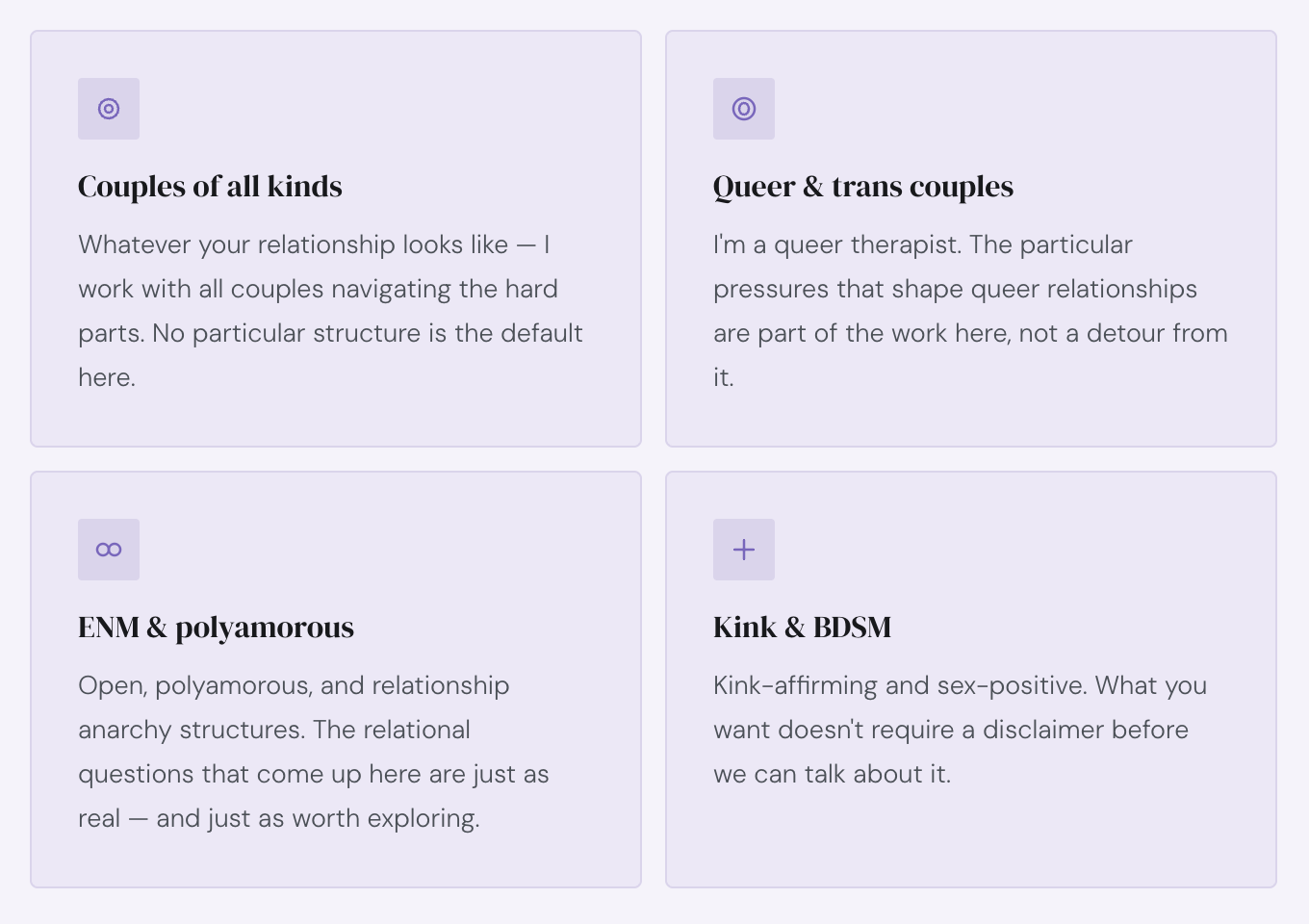
All relationship structures welcome
Before I became a clinician, I spent years as a performer and teaching artist. That experience taught me something I carry into every session: how much gets communicated in what isn't said. The pause before an answer, the shift in tone when a partner's name comes up, the thing that almost got said and then didn't.
In couples work, that quality of attention matters a great deal. I'm listening to both people simultaneously — not just to what each person says, but to what happens in the space between them.
The Practical Stuff
Fees: Relationship therapy sessions are $250 for 60 minutes. I'm an out-of-network provider — I'll give you a superbill after each session to submit to your insurance for potential reimbursement.
Location: I'm based in New York City at The Sexuality, Attachment, and Trauma Project, and licensed in New York, New Jersey, and Pennsylvania.
Getting started: Reach out through the contact page with a few sentences about what's bringing you here. You don't need to have it figured out. I'll follow up to schedule a brief consultation.
Ready to reach out?
You don't need to have it figured out first.
Tell me a little about where things are between you. That's enough to start.