
You probably already know something is getting in the way. You've read the books, done the reflection, maybe even gone to therapy before. And still, the same patterns, the same moments where you go quiet or go sideways or end up somewhere you didn't mean to be.
That's not a failure of insight. It's an invitation to go deeper.
I'm Mackenzie, a therapist in New York City who works with individuals and couples ready to get genuinely curious about the parts of themselves they usually avoid. Not to dismantle them, but to understand what they were built to protect. That's where real change starts.

About Me
I've always been more interested in the question underneath the question. What someone is really asking when they say they want to stop fighting with their partner, or can't figure out why they keep ending up in the same place.
What I keep coming back to, after years doing this work, is how much our earliest relationships quietly run the show. The way we learned to get close, or stay safe by not getting too close, doesn't disappear in adulthood. It shows up in who we're drawn to, how we fight, what we can't quite say out loud, and what we protect ourselves from feeling.
I'm a queer therapist practicing in New York City, and I built this practice with a specific kind of person in mind. Someone who wants a space where their full self is assumed to be welcome, not just accommodated. Identity, desire, shame, power. None of that is a detour from the real work here.
Before I became a clinician, I spent years as a performer and teaching artist. That background taught me to listen for what isn't said: the pause, the shift in register, the thing that almost came out. I pay attention to all of it.
I offer in-person sessions in Manhattan, near the Upper West Side, Hell's Kitchen, and Midtown, and telehealth across New York, New Jersey, and Pennsylvania through The Sexuality, Attachment, and Trauma Project.
My Approach
Most people who come to therapy don't need to be fixed. They need to understand themselves more honestly. The defenses we build to protect ourselves from being hurt are genuinely brilliant. They worked. The problem is they keep working long after we've outgrown the circumstances that made them necessary. Sometimes the very thing that once kept us safe is now keeping us from the closeness, or the change, we actually want.
In our work together, I'm not trying to talk you out of those defenses. I'm curious about them. Where they came from, what they were built to protect, and whether they still need to be running the show.
Sessions tend to feel intellectually alive. We're making meaning together, not just processing feelings. I'll notice things out loud and occasionally ask the question you weren't quite expecting.
Specialties
Most people don't arrive with a clean category. They arrive with a feeling — stuck, disconnected, exhausted by a pattern they can't shake. Some arrive alone. Some arrive with a partner. The areas below reflect where I do my deepest work.
-
Sometimes you can't name what's wrong, only that who you've been doesn't quite fit anymore. Whether you're grieving, navigating a divorce, rethinking your career, moving through a breakup, or quietly asking who am I now? We figure out what you actually want, not what you're supposed to want.
-
Grief doesn't always look like loss. Sometimes it looks like rage, numbness, or the sudden inability to trust. I work with people carrying grief from betrayal, breakups, identity shifts, or dreams that quietly collapsed. We go at your pace, and we tend to what the loss actually meant, not just what happened.
-
If you keep ending up in the same argument, shutting down when things get close, struggling to say what you actually need, or finding that your boundaries collapse exactly when you need them most. We'll look at the patterns shaped long before this relationship. Understanding where they came from, and how they show up as anxiety, conflict, or shutdown, is what actually changes them. If you find yourself anxiously waiting to hear back, reading into tone, or going completely silent when things get hard, this is the work.
-
Most couples don't arrive in crisis. They arrive after a long time of not quite saying the thing, or saying it badly, or stopping saying it altogether. Sometimes there's been a betrayal. Sometimes it's subtler: a distance that grew so gradually neither of you noticed.
In couples work, the relationship itself is the client. I work with all structures: monogamous, ENM, polyamorous, queer, and kink.
-
You shouldn't have to explain yourself before getting to the real work. This is a space where queer and trans identities aren't accommodated, they're centered. Whether you're untangling internalized shame, navigating a gender transition, or simply tired of being the educator in your own therapy, you can arrive here and just be.
-
Desire is one of the most honest things about us and one of the most loaded. I work with people navigating desire differences, shame around what they want, intimacy that has stalled, or patterns that don't match their values. Kink, non-monogamy, queer relationships. Nothing here requires a disclaimer before you say it.
Who I Work With
Most of the people I work with are thoughtful, self-reflective, and quietly tired of understanding themselves without being able to change.
You might be someone who:
keeps ending up in the same dynamic, no matter how different the person seems at first
goes quiet or goes cold at exactly the wrong moment, and isn't sure why
wants real intimacy but finds yourself pulling back when it gets close
you and your partner keep having the same fight and neither of you knows how to stop
is carrying stress or burnout that has started to feel like it's coming from somewhere deeper than work
is queer, trans, or in a non-traditional relationship and wants a therapist who doesn't need things explained
is rebuilding after a betrayal, loss, or rupture that changed how you see yourself
simply feels like the version of yourself you're living doesn't quite fit anymore
If any of that lands, I'd love to hear from you.
My Values in Therapy
Therapy should feel like a place where you don't have to shrink. Here, your full identity isn't just tolerated. It's the starting point. Conversations about race, power, gender, and culture aren't detours from the work. They're often the heart of it.
If something feels off between us, I want to know. Feedback isn't a disruption. It's information. And repair, when it's needed, is part of what we're here to practice. That includes how we set up the work itself. If you have accessibility needs, please tell me and we'll figure it out together.
Fees and Insurance
Please contact me to schedule a free 20-minute consultation and we can discuss fees.
I'm an out-of-network provider. A lot of people assume out-of-network means paying full price out of pocket forever. That's not always true. If you have a PPO plan, your insurance may reimburse a meaningful portion of session fees. The easiest way to find out: call the number on your insurance card and ask about your out-of-network outpatient mental health benefit. I provide a superbill after each session that makes the reimbursement process straightforward.
I keep a small number of sliding-scale spots open. If cost is standing between you and getting support, reach out. I mean it.
Current Group Offering
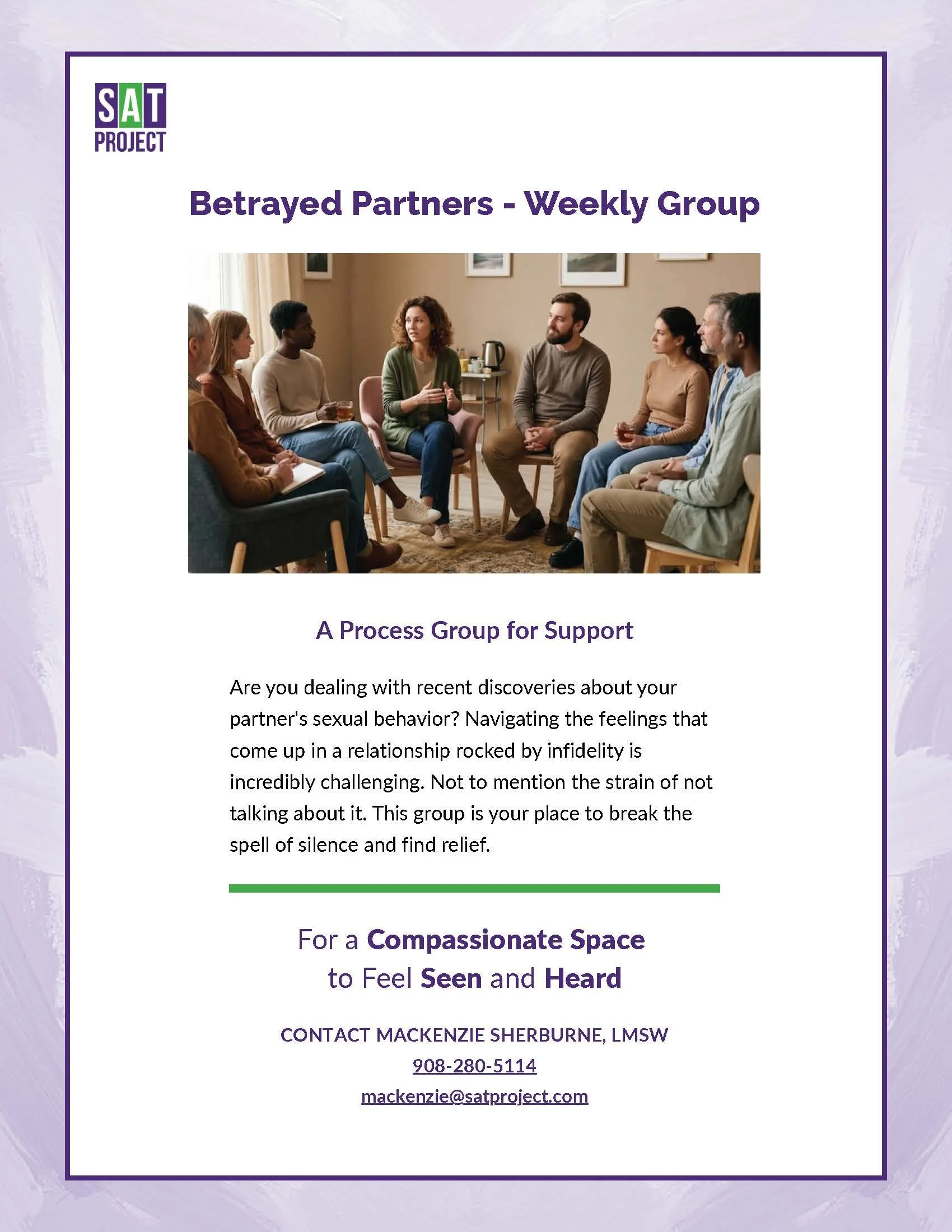
I’m currently leading a weekly processing group for partners navigating the emotional impact of betrayal trauma. This group is designed to support people who are feeling overwhelmed, self-blaming, or unsure what comes next—and who want a space that centers their experience without pressure to forgive, decide, or “move on.”
The group moves at a steady, compassionate pace and is intentionally shaped to reduce shame and help partners rebuild trust in themselves through connection with others.
Contact Me
Schedule a free 20-minute consultation to see if we might be a good fit or feel free to reach out with any questions you might have.
✉️ Mackenzie@satproject.com
📞 908-280-5114